

The Glasgow 2026 Commonwealth Games made history before a single race was run.
For the first time ever, the very first medal of the Games was awarded in a Para sport — Para powerlifting. It wasn't a footnote. It wasn't a side event. It was the opening act. And with six of ten sports at Glasgow 2026 featuring Para events, and more than 450 Para athletes competing alongside their able-bodied counterparts across the eleven-day programme, the message was clear: Para sport belongs at the centre of the conversation.
At SWSM, the Games carry special meaning this year. Our own physiotherapist Chris Ius is representing Australia in Glasgow as part of the Men's 4x100m Relay squad — a team that includes some of the fastest sprinters in the country. Chris has run sub-10.2 seconds for the 100m and was part of the Australian relay team that broke the national record in 2025. Watching one of our own clinicians compete at this level is a reminder of something we believe deeply: the people treating you understand elite performance because they live it.
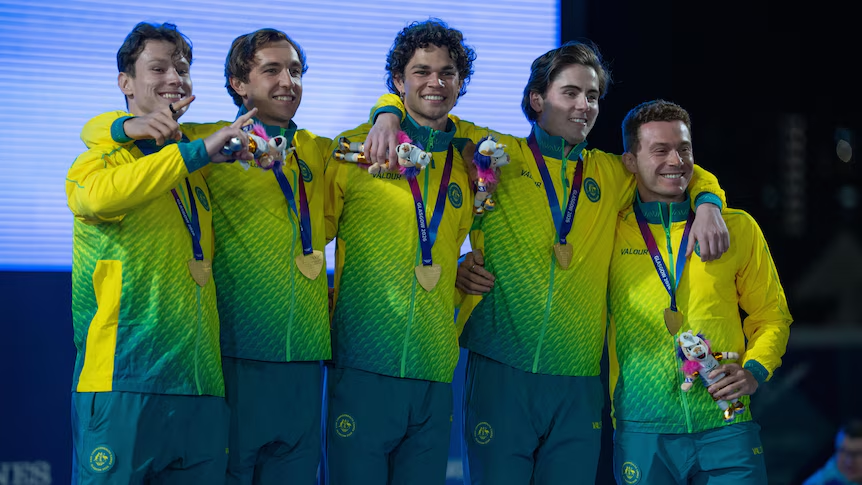
Closer to home on the competition floor, two of SWSM's own patients — Tru Hagens and Ben Foster — are part of the Australian Men's Artistic Gymnastics team that claimed bronze in the team event at Glasgow, ending a 16-year Commonwealth Games medal drought for Australian
men's gymnastics. It was a dramatic finish, with the team holding off a raucous home crowd and the hosts Scotland on the final apparatus to seal their place on the podium. Tru Hagens put it best after the win: "We all grew up together, so we're just one big bunch of friends. It's pretty amazing seeing all of us accomplish this together."
We couldn't be prouder of all three of them.
These connections matter to us — not just because they make for a great story, but because they reflect what's possible when the right support, the right training environment, and the right clinical team come together behind an athlete.
The principles that underpin how elite athletes — Para and able-bodied alike — train, recover, and push their bodies further translate directly into how we approach rehabilitation for every
patient, regardless of whether a gold medal is on the line. Here are the lessons that matter most.
1. Rehabilitation Starts With What the Body Can Do — Not What It Can't
One of the most common barriers people face when starting rehabilitation is a mental one: the focus on limitation. What they've lost. What they can no longer do. What hurts.
Para athletes reframe this entirely.
A Para powerlifter competing at Glasgow 2026 isn't training around what their body can't do — they're maximising what it can. A swimmer with a limb difference isn't compensating; they're developing a stroke technique built precisely for their body. A wheelchair basketball player isn't adapting a mainstream sport; they're competing in a discipline that demands elite levels of upper body strength, spatial awareness, and anaerobic conditioning.
This is a principle clinical exercise physiologists apply every day. The starting point for any good rehabilitation program isn't a list of contraindications — it's an honest assessment of current capacity, followed by a plan to build progressively from there. Every body has a starting point. The goal is to find it and work forward.
2. Adaptation Is Not Compromise — It's Clinical Precision
Para athletes compete using assistive technology, modified techniques, and carefully tailored training programs. None of this is settling for less. It's precision medicine applied to sport.
Australia sent 23 Para athletes to Glasgow 2026 as part of its athletics squad alone — the largest athletics contingent of any nation at the Games. Each of those athletes trains alongside able-bodied teammates with a support team that includes physiotherapists, exercise physiologists, sports physicians, and coaches who understand the specific biomechanical demands of their event.
Our own Chris Ius is a working example of this. As both a practising physiotherapist and an elite sprinter, Chris understands the relationship between clinical precision and athletic performance from both sides of the treatment table. A relay sprinter's program isn't just about speed — it's about baton exchange timing, hip flexor power, acceleration mechanics, and recovery between rounds of competition. Every element is tailored. Nothing is generic.
What that looks like in practice for Para athletes specifically: a T-class sprinter requires hip flexor and core strength that compensates for reduced contribution from the lower limb. A Para swimmer builds shoulder and trunk power to drive propulsion without the leg kick that able-bodied swimmers rely on. Every program is built around the individual — their classification, their sport, their body.
This is the same approach SWSM takes for every patient. There is no generic rehabilitation program that works for everyone. What works is a thorough clinical assessment, a clear understanding of what the person is working toward, and a program that's adapted specifically for them — not borrowed from a textbook.
3. Movement Is Medicine — Even When It Looks Different to What You Expected
One of the most consistent findings in exercise science is that structured physical activity improves outcomes across virtually every chronic condition: diabetes, cardiovascular disease, arthritis, neurological conditions, mental health, and musculoskeletal pain.
Para athletes demonstrate this in the most visible way possible. Many of the athletes who competed at Glasgow 2026 live with conditions that their treating clinicians might once have considered barriers to elite sport. Instead, sport — and the structured training behind it — became part of how they manage their health, build resilience, and maintain function over the long term.
For SWSM's patients, this principle matters regardless of whether a gold medal is on the horizon. A patient managing Parkinson's Disease who works with an Exercise Physiologist on balance and strength isn't training like a Para athlete in every respect — but they are applying the same core principle: that purposeful, progressive, clinician-designed exercise improves how the body functions over time.
The same is true for patients managing Multiple Sclerosis, Cerebral Palsy, spinal cord injuries, Type 2 Diabetes, or any condition where movement might feel harder than it looks. The research is clear — and Para athletes at the highest level of world sport are living proof.
4. Mental Resilience Is a Trainable Skill, Not a Personality Trait
Behind every athlete on the Glasgow 2026 podium is a story that involves setback, adaptation, and the decision to keep going. That's not incidental to their achievement — it's central to it.
The Australian Men's Gymnastics team is a case in point. Four years ago in Birmingham, they missed bronze by just 0.650 points. That near-miss was devastating — but for Ben Foster, Tru Hagens, and their teammates, it became fuel. At Glasgow, facing a loud home crowd willing Scotland into contention on the final apparatus, the team held their nerve on the pommel horse and secured bronze with a combined score of 235.650. It was Australia's first men's gymnastics team medal since their gold at the 2010 Delhi Games — and it was achieved with four of five athletes making their Commonwealth Games debut.
Sports psychology research consistently shows that the mental skills athletes develop — goal-setting, self-regulation, managing uncertainty, building confidence through incremental progress — are the same skills that predict positive outcomes in rehabilitation for everyone.
For a patient recovering from joint replacement, returning to sport after a significant injury, or rebuilding fitness after a long period of inactivity, the psychological dimension of recovery is as real as the physical one. Fear of re-injury, loss of identity around sport, frustration with the pace of progress — these are not weaknesses. They are normal responses to abnormal situations. And they are addressable.
This is why SWSM's Sports Psychologists work closely with our physiotherapy and exercise physiology teams. Rehabilitation that addresses only the physical body misses half the picture.
5. Integration Produces Better Outcomes Than Isolation
Glasgow 2026 was the most integrated Commonwealth Games in history — Para athletes competing alongside able-bodied athletes, Para medals counting equally in the national tally, Para sport opening the Games. That integration wasn't cosmetic. It reflected a fundamental shift in how we understand disability, performance, and the relationship between them.
In rehabilitation, integration works the same way. A patient doesn't recover in isolation — they recover within a team. At SWSM, that means physiotherapists, sports physicians, exercise physiologists, podiatrists, sports psychologists, and hydrotherapy practitioners working from a shared understanding of each patient's goals. When your physiotherapist knows what your exercise physiologist is prescribing, and your sports physician knows how your psychological recovery is tracking, the whole program works better than any individual component.
This is the model that elite Para sport has always required — and it's the model that produces the best outcomes for everyday patients too.
What This Means for You
You don't need to be a Para athlete to benefit from the principles they've refined. You don't need a diagnosis, a disability classification, or an elite training background. What you need is a team that takes your body seriously, designs a program that's built for where you are right now, and helps you move toward where you want to be.
That's what we do at Sydney West Sports Medicine — for patients with NDIS funding, for those in post-surgical rehabilitation, for people managing lifelong conditions, and for anyone who wants to understand what their body is genuinely capable of.
We're cheering on Chris, Tru, Ben, and every Australian athlete still competing in Glasgow. And we're proud that the same clinical environment that supports our patients every day also plays a role in getting athletes to the highest stage in Commonwealth sport.
If Glasgow 2026 has inspired you to take the next step in your own rehabilitation or fitness journey, we'd love to help.
Book an appointment → �� 1300 13 SWSM | reception@swsm.com.au
Sydney West Sports Medicine is Western Sydney's largest sports medicine and rehabilitation clinic. We accept NDIS, Workers Compensation, Medicare, DVA, and private patients across our locations at West HQ Rooty Hill, BEST Rooty Hill, Norwest, Athletics NSW at Sydney Olympic Park, and Homebush.